Pesquisar Neste Blog

terça-feira, 15 de março de 2011

Veterinary Surgery American College of Veterinary Surgeons - SI Journal Citation Reports © Ranking: 2009: 27/141 (Veterinary Sciences)


Original Articles

  1. You have full text access to this content
    Pathologic Fracture in Dogs with Suspected or Confirmed Osteosarcoma

    Jitender Bhandal and Sarah E. Boston

    Article first published online: 11 MAR 2011 | DOI: 10.1111/j.1532-950X.2011.00811.x

  2. You have full text access to this content
    Partial Ostectomy of the Dens to Correct Atlantoaxial Subluxation in a Pony

    Eugenio Cillán-Garcia, Sarah E. Taylor, Neil Townsend and Theresia Licka

    Article first published online: 11 MAR 2011 | DOI: 10.1111/j.1532-950X.2011.00816.x

  3. You have full text access to this content
    Evaluation of a Minimally Invasive Arthrodesis Technique for the Carpometacarpal Joint in Horses

    Luca Panizzi, Spencer M. Barber, Hayley M. Lang, Andrew L. Allen and Murray R. Woodbury

    Article first published online: 11 MAR 2011 | DOI: 10.1111/j.1532-950X.2011.00810.x

  4. You have full text access to this content
    Lingual Arch Bar Application for Treatment of Rostral Mandibular Body Fractures in Cats

    Mehmet Alper Çetinkaya, Cenk Yardimci and Umit Kaya

    Article first published online: 11 MAR 2011 | DOI: 10.1111/j.1532-950X.2011.00809.x

  5. You have full text access to this content
    Effects of Extracorporeal Shock Wave Therapy on Desmitis of the Accessory Ligament of the Deep Digital Flexor Tendon in the Horse

    Wayne Waguespack, Daniel J. Burba, Jeremy D. Hubert, Martin A. Vidal, Larry G. Lomax, Sharon R. Chirgwin and Mandi J. Lopez

    Article first published online: 11 MAR 2011 | DOI: 10.1111/j.1532-950X.2011.00800.x

  6. You have full text access to this content
    Surgical Repair of a Complete Endocardial Cushion Defect in a Dog

    Shigeki Yamano, Masami Uechi, Katsuyuki Tanaka, Yasutomo Hori, Takashi Ebisawa, Kayoko Harada and Takahiro Mizukoshi

    Article first published online: 11 MAR 2011 | DOI: 10.1111/j.1532-950X.2011.00797.x

  7. You have full text access to this content
  8. You have full text access to this content
    Desmotomy of the Accessory Ligament of the Deep Digital Flexor Tendon in the Forelimb of 24 Horses 2 Years and Older

    Stavros Yiannikouris, Robert K. Schneider, Sarah N. Sampson and Greg Roberts

    Article first published online: 1 MAR 2011 | DOI: 10.1111/j.1532-950X.2011.00815.x

  9. You have full text access to this content
    Outcome after Lacerations of the Superficial and Deep Digital Flexor Tendons, Suspensory Ligament and/or Distal Sesamoidean Ligaments in 106 Horses

    Mireia Jordana, Hans Wilderjans, Jane Boswell, Jeroen Dewulf, Roger K. W. Smith and Ann Martens

    Article first published online: 1 MAR 2011 | DOI: 10.1111/j.1532-950X.2011.00814.x

  10. You have full text access to this content
    Toggle-Pin Technique for Management of Coxofemoral Luxation in an Alpaca

    Diego D. Quinteros, José M. García-López and Thomas Jenei

    Article first published online: 1 MAR 2011 | DOI: 10.1111/j.1532-950X.2011.00812.x

  11. You have full text access to this content
    Locking Compression Plate Osteosynthesis of Sacral Fractures in Three Heifers

    Tanja C. Schmid, Martin R. Kummer, Regine U. Hagen, Jörg A. Auer and Karl A. Nuss

    Article first published online: 1 MAR 2011 | DOI: 10.1111/j.1532-950X.2011.00808.x

  12. You have full text access to this content
    Ex Vivo Biomechanical Evaluation of the Canine Cranial Cruciate Ligament-Deficient Stifle with Varying Angles of Stifle Joint Flexion and Axial loads after Tibial Tuberosity Advancement

    Daniel E. Hoffmann, Michael P. Kowaleski, Kenneth A. Johnson, Richard B. Evans and Randy J. Boudrieau

    Article first published online: 1 MAR 2011 | DOI: 10.1111/j.1532-950X.2011.00807.x

  13. You have full text access to this content
    A Surgical Technique for Implantation of the Vibrant Soundbridge Middle Ear Implant in Dogs

    Gert Ter Haar, Jef J. Mulder, Anjop J. Venker-van Haagen, Freek J. van Sluijs and Guido F. Smoorenburg

    Article first published online: 1 MAR 2011 | DOI: 10.1111/j.1532-950X.2011.00806.x

  14. You have full text access to this content
    Axial Pattern Flap Based on a Cutaneous Branch of the Facial Artery in Cats

    Joshua Milgram, Maya Weiser, Efrat Kelmer and Hadas Benzioni

    Article first published online: 1 MAR 2011 | DOI: 10.1111/j.1532-950X.2011.00803.x

  15. You have full text access to this content
    Acetabular Ventroversion with Double Pelvic Osteotomy Versus Triple Pelvic Osteotomy: A Cadaveric Study in Dogs

    John P. Punke, Derek B. Fox, James L. Tomlinson, J. Wade Davis and F. A. Mann

    Article first published online: 1 MAR 2011 | DOI: 10.1111/j.1532-950X.2011.00802.x

  16. You have full text access to this content
    In Vitro Comparison of Proximal Ulnar Osteotomy and Distal Ulnar Osteotomy with Release of the Interosseous Ligament in a Canine Model

    Kelly R. Might, Kimberly A. Hanzlik, Joseph Brad Case, Colleen G. Duncan, Erick L. Egger, Matthew B. Rooney and Felix M. Duerr

    Article first published online: 1 MAR 2011 | DOI: 10.1111/j.1532-950X.2011.00805.x

  17. You have full text access to this content
    Evaluation of a Tenoscopic Approach for Desmotomy of the Accessory Ligament of the Deep Digital Flexor Tendon in Horses

    Fred J. Caldwell and R. Wayne Waguespack

    Article first published online: 1 MAR 2011 | DOI: 10.1111/j.1532-950X.2011.00801.x

  18. You have full text access to this content
    In Vitro Effect of Ventriculocordectomy Before Laryngoplasty on Abduction of the Equine Arytenoid Cartilage

    Justin D. Perkins, Hazel Meighan, Zoë Windley, Susanne Troester, Richard Piercy and Jim Schumacher

    Article first published online: 11 FEB 2011 | DOI: 10.1111/j.1532-950X.2011.00796.x

  19. You have full text access to this content
    Intrathecal Deep Digital Flexor Tenectomy for Treatment of Septic Tendonitis/Tenosynovitis in Four Horses

    Chad A. Marsh, Jeffery P. Watkins and Robert K. Schneider

    Article first published online: 11 FEB 2011 | DOI: 10.1111/j.1532-950X.2011.00795.x

  20. You have full text access to this content
    Use of Skin Stretchers to Elongate a Peninsular Thoracodorsal Axial Pattern Flap for Antebrachial Wound Closure in a Dog

    David E. Holt and Jeffrey Runge

    Article first published online: 11 FEB 2011 | DOI: 10.1111/j.1532-950X.2011.00790.x

  21. You have full text access to this content
    Multivariate Analysis of Morphometric Characteristics to Evaluate Risk Factors for Cranial Cruciate Ligament Deficiency in Labrador Retrievers

    Chantal A. Ragetly, Richard Evans, Ayman A. Mostafa and Dominique J. Griffon

    Article first published online: 11 FEB 2011 | DOI: 10.1111/j.1532-950X.2010.00787.x

  22. You have full text access to this content
    Mechanical Comparison of Two Suture Constructs For Extra-Capsular Stifle Stabilization

    Nic R. Cabano, Kevin L. Troyer, Ross H. Palmer, Christian M. Puttlitz and Brandon G. Santoni

    Article first published online: 11 FEB 2011 | DOI: 10.1111/j.1532-950X.2010.00775.x

  23. You have full text access to this content
    Evaluation of Ethyl Alcohol for Use in a Minimally Invasive Technique for Equine Proximal Interphalangeal Joint Arthrodesis

    Ryan R.E. Wolker, David G. Wilson, Andrew L. Allen and James L. Carmalt

    Article first published online: 18 JAN 2011 | DOI: 10.1111/j.1532-950X.2010.00794.x

  24. You have full text access to this content
    Management of Femoral Fractures in Dogs with Unilateral Semicircular External Skeletal Fixators

    Cenk Yardimci, Ahmet Ozak and H.Ozlem Nisbet

    Article first published online: 18 JAN 2011 | DOI: 10.1111/j.1532-950X.2010.00793.x

  25. You have full text access to this content
    Evaluation of Composite Resin Materials for Maxillomandibular Fixation in Cats for Treatment of Jaw Fractures and Temporomandibular Joint Luxations

    Melissa Hoffer, Sandra Manfra Marretta, Peter Kurath, Ann Johnson, Dominique Griffon, David Schaeffer, Gerald Pijanowski and John Przywara

    Article first published online: 18 JAN 2011 | DOI: 10.1111/j.1532-950X.2010.00782.x

  26. You have full text access to this content
    Treatment of Epiglottic Entrapment by Transnasal Axial Division in Standing Sedated Horses Using a Shielded Hook Bistoury

    Mathieu Lacourt and Marcel Marcoux

    Article first published online: 4 JAN 2011 | DOI: 10.1111/j.1532-950X.2010.00781.x

Cientistas controlam ansiedade no cérebro usando luz

Cientista controlam ansiedade no cérebro usando luz
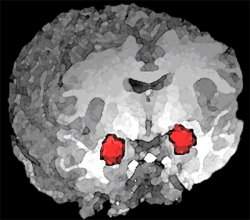
Agora que sabem da existência das rotas celulares específicas para ativação e desativação da ansiedade, os cientistas vão começar a efetuar testes para tentar inibir seus efeitos. Esta imagem de ressonância magnética mostra as amígdalas no cérebro humano.
Rotas da ansiedade
Cientistas da Universidade de Stanford, nos Estados Unidos, usaram luz para identificar com precisão os circuitos neurais responsáveis pela ansiedade.
Trabalhando com animais de laboratório, os cientistas identificaram duas rotas principais no cérebro: uma que promove a ansiedade e outra que alivia a ansiedade.
Os transtornos de ansiedade são os mais prevalentes entre as doenças psiquiátricas, e incluem doenças como o transtorno de estresse pós-traumático, transtorno obsessivo-compulsivo e fobias. A ansiedade também contribui para outros importantes transtornos psiquiátricos, como a depressão e abuso de substâncias.
Amígdala cerebral
As rotas agora localizadas estão em uma região do cérebro chamada amígdala.
A amígdala está envolvida em vários processos, incluindo a sociabilidade e o medo, e também já era sabido que ela desempenha um papel na ansiedade.
Mas as pesquisas anteriores precisaram de modificações generalizadas da amígdala, por meio de drogas ou de sua ruptura física, métodos de força bruta que trazem pouco conhecimento prático para o tratamento dos efeitos produzidos em qualquer região do cérebro.
Optogenética
Agora os cientistas usaram uma ferramenta bem mais suave, a luz, resultado de pesquisas em uma área emergente conhecida como optogenética.
A optogenética combina genética e ciência óptica para manipular seletivamente a forma como um neurônio dispara no cérebro. Os neurônios são células eletricamente excitáveis que transmitem informações através de sinalizações elétricas e químicas.
As manipulações genéticas dirigidas induzem neurônios específicos a produzir uma proteína ativada pela luz normalmente encontrada em algas e bactérias.
Quando acionadas por certos comprimentos de onda da luz, estas proteínas permitem que os cientistas aumentem ou diminuam a atividade neuronal no cérebro e observem os efeitos dessa atividade sobre o comportamento dos animais de laboratório.
Diferença entre medo e ansiedade
Embora a optogenética já tivesse sido utilizada antes para estudar a função da amígdala no medo, esta é a primeira vez que a técnica é utilizada para estudar a ansiedade.
"Medo e ansiedade são diferentes", explica Karl Deisseroth, coordenador da pesquisa. "O medo é uma resposta a uma ameaça imediata, mas a ansiedade é um estado de elevada apreensão sem nenhuma ameaça imediata. Eles compartilham os mesmos efeitos, por exemplo, manifestações físicas tais como aumento da frequência cardíaca, mas seus controles são muito diferentes."
Agora que sabem da existência das rotas celulares específicas para ativação e desativação da ansiedade, os cientistas vão começar a efetuar testes para tentar inibir seus efeitos de forma mais duradoura.
Ainda não há previsão de quando os testes começarão a ser feitos em humanos.

Miniature 'Wearable' PET Scanner: Simultaneous Study of Behavior and Brain Function in Animals

ScienceDaily (Mar. 14, 2011) — Scientists from the U.S. Department of Energy's (DOE) Brookhaven National Laboratory, Stony Brook University, and collaborators have demonstrated the efficacy of a "wearable," portable PET scanner they've developed for rats. The device will give neuroscientists a new tool for simultaneously studying brain function and behavior in fully awake, moving animals.
PET scans of a rat's brain made with the RatCAP scanner (horizontal view superimposed on a rat brain atlas figure, left, and a coronal slice, right). The rainbow scale (red = high, violet = low) indicates the level of a radiotracer that binds to receptors for dopamine, which are concentrated in the striatum, a brain region involved in reward and motivation. 
The researchers describe the tool and validation studies in the April 2011 issue of Nature Methods.

"Positron emission tomography (PET) is a powerful tool for studying the molecular processes that occur in the brain," said Paul Vaska, head of PET physics at Brookhaven with a joint appointment at Stony Brook, who led the development of the portable scanner together with Brookhaven colleagues David Schlyer and Craig Woody. PET studies in animals at Brookhaven and elsewhere have helped to uncover the molecular underpinnings of conditions such as drug addiction.

But studying animals with PET has required general anesthesia or other methods to immobilize the animals. "Immobilization and anesthesia make it impossible to simultaneously study neurochemistry and the animals' behavior -- the actions resulting from what goes on in the brain," Schlyer said. "Our approach was to eliminate the need for restraint by developing a PET scanner that would move with the animal, thus opening up the possibility of directly correlating the imaging data with behavioral data acquired at the same time."

After several years of development, the scientists have arrived at a design for a miniature, portable, donut-shaped PET scanner that can be "worn" like a collar on a rat's head for simultaneous studies of brain function and behavior. Weighing only 250 grams, the device -- dubbed RatCAP, for Rat Conscious Animal PET -- is counterbalanced by a system of springs and motion stabilizers to allow the animal significant freedom of movement. Measurements of the rats' stress hormones indicated only moderate and temporary increases.

"Rats wearing the device appear to adapt well and move freely about their environment," Woody said.

To validate the use of the wearable scanner for simultaneous studies of brain function and behavior, the scientists conducted tests with 11C-raclopride, a commonly used PET radiotracer, which incorporates a radioactive, positron-emitting isotope of the element carbon. When the positrons interact with electrons in ordinary matter, they immediately annihilate one another, emitting back-to-back gamma rays. Detectors in the circular PET scanner pick up the signals from these back-to-back gamma rays to identify the location and concentration of the tracer in the body.

The tracer 11C-raclopride binds to receptors for dopamine, a brain chemical involved in movement, reward, and memory formation. A higher signal from the tracer means that less natural dopamine is in that particular part of the brain; a low signal indicates that that particular part of the brain has released dopamine (which binds to its receptors, thus blocking the tracer from binding).

The main test was to see if the wearable scanner could be used to correlate dopamine levels with behavior -- in this case, the rats' activity (i.e., movement) within their chambers. Surprisingly the level of activity was inversely related to dopamine levels -- that is, the more active the animals were, the lower the level of dopamine (as indicated by a stronger tracer signal).

"This is perhaps a counterintuitive result because behavioral activation is typically associated with an increase in dopamine release," said Daniela Schulz, a Brookhaven behavioral neuroscientist and lead author of the paper. "So our method provides data which may challenge traditional paradigms and ultimately improve our understanding of the dopamine system."

"But regardless of the direction, the results clearly demonstrate that RatCAP can correlate brain function measurements with behavioral measures in a useful way," she said.

The scientists also present results comparing RatCAP-wearing rats moving freely about their cages with animals that had been anesthetized, as well as comparisons of two methods of administering the tracer -- injecting it all at once and in a steady infusion to maintain a constant concentration in the blood.

"These measurements will help us further refine the technique and aid in our assessment of results obtained with RatCAP in comparison with other study techniques," Schulz said.

The researchers' next step will be to use RatCAP to explore distinct behavioral expressions that can be correlated with simultaneously acquired PET data.

The research was funded by the DOE Office of Science. Development of RatCAP was a joint effort between Brookhaven's Medical, Chemistry and Physics Departments, Instrumentation Division and the Biomedical Engineering Department at Stony Brook University. Co-authors on the paper include: Daniela Schulz (Brookhaven), Sudeepti Southekal (Brigham & Women's Hospital, Boston),Sachin S. Junnarkar (Brookhaven), Jean-François Pratte (Université de Sherbrooke, Sherbrooke, Canada), Martin L. Purschke (Brookhaven), Paul O'Connor (Brookhaven), Sean P. Stoll (Brookhaven), Bosky Ravindranath (Stony Brook), Sri Harsha Maramraju (Stony Brook), Srilalan Krishnamoorthy (Stony Brook), Fritz A. Henn (Brookhaven and Cold Spring Harbor Laboratory), Craig L. Woody (Brookhaven), and David J. Schlyer and Paul Vaska (Brookhaven and Stony Brook).

Potential Way to Protect Neurons in Parkinson's, Alzheimer's, ALS

ScienceDaily (Mar. 14, 2011) — Cell biologists pondering the death of neurons -- brain cells -- have now shown that by eliminating one ingredient from the cellular machinery, they prolonged the life of neurons stressed by a pesticide chemical. The finding identifies a potential therapeutic target to slow changes that lead to neurodegenerative disorders such as Parkinson's and Alzheimer's diseases.
This is an illustration of a healthy neuron. A UT Health Science Center San Antonio study found a protective mechanism for neurons placed under mitochondrial stress.
The researchers, from The University of Texas Health Science Center San Antonio, found that neurons lacking a substance called caspase-2 were better able to withstand pesticide-induced damage to energy centers known as mitochondria.

Master switch

Caspase-2 appears to be a master switch that can trigger either cell death or survival depending on the amount of cellular damage, the team found. Neurons that lacked caspase-2 showed an increase in protective activities, including the efficient breakdown of obsolete or used proteins. This process, called autophagy, delays cell death.

"This research shows, for the first time, that in the absence of caspase-2 neurons increase autophagy to survive," said study co-author Marisa Lopez-Cruzan, Ph.D., investigator in the cellular and structural biology department at the Health Science Center.

Role of energy centers

Evidence suggests that mitochondrial dysfunction plays an important role in neuronal death in conditions such as Parkinson's disease, Alzheimer's disease, amyotrophic lateral sclerosis (ALS, or Lou Gehrig's disease) and Huntington's disease.

"Identifying initiators in the cell death process is important for determining therapeutic approaches to provide the maximum protection of neurons during neurodegenerative conditions," said senior author Brian Herman, Ph.D., vice president for research and professor of cellular and structural biology at the Health Science Center.

Young adult mice

The team studied neurons from young adult mice. This was intended to model the early changes that take place in neurodegenerative diseases.

The research is in the March 11 issue of the Journal of Biological Chemistry.

Dr. Lopez-Cruzan, director of Dr. Herman's laboratory, came up with the idea that caspase-2 protects cells from mitochondrial stress. Meenakshi Tiwari, Ph.D., postdoctoral fellow, expanded upon the initial work and is first author of the paper.

The work was supported by the National Institute on Aging and is part of a second National Institutes of Health MERIT award to Dr. Herman.

Salmonella Bacteria Used to Fight Cancer

ScienceDaily (Mar. 14, 2011) — University of Minnesota researchers are using salmonella -- the bacteria commonly transmitted through food that sickens thousands of U.S. residents each year -- to do what was once unthinkable: help people.

U of M Masonic Cancer Center researchers believe salmonella may be a valuable tool in the fight against cancer in organs surrounding the gut -- such as the liver, spleen, and colon -- since that's where salmonella naturally infects the body.

Researchers want to "weaponize" salmonella, allowing the bacteria to then attack cancer cells in its natural environment.

U of M trials in animals have already shown salmonella can successfully control tumors in the gut. Human clinical trials are already underway at the U of M and are showing promise.

"Many bacteria and viruses -- even harmful ones -- can be used to fight disease," said Edward Greeno, M.D., lead researcher on the clinical study and Medical Director of the Masonic Cancer Clinic. "We believe it may even be possible to use bacteria to fight cancer."

Scientists have known for centuries that cancer patients sometimes get better after they've been exposed to an infection. For example, Greeno said, there is a published Austria report from the 1860's on a patient with a large tumor. The patient was placed in the same room as another sick patient with a bad infection. Soon, the tumor became infected and began to shrink in the original patient and nearly disappeared.

Unfortunately, the infection also killed the patient with the tumor.

So the key for this research initiative, Greeno said, was to find a way to get the tumor fighting abilities of salmonella delivered to the patient -- without making the patient sick.

What they came up with:
Greeno's Medical School colleague, Dan Saltzman, M.D., Ph.D., genetically modified a batch of salmonella to weaken it and added Interleukin 2, or IL-2. "You could think of IL-2 as a guard dog that sniffs around looking for threats inside the body." he said. When it finds one, it calls in an attack by the immune system.
Researchers knew if they could make IL-2 near tumors, it would identify the cancerous cells as a threat and trigger an immune response near the tumor.
Salmonella naturally finds its way to a person's gut and associated tissues. Salmonella also naturally likes to grow inside of tumor cells. Hence, if you're looking for ways to treat cancer in the bowels, the nearby lymph nodes or the liver -- salmonella is a perfect method to deliver a package of IL-2.

In a nutshell, by using genetically modified salmonella packaged with IL-2, Medical School researchers have created a kind of two-prong attack on cancer -- the immune response called in by IL-2, and the salmonella itself. The therapy is administered simply -- mixed with a few ounces of water and imbibed orally.

"This probably won't replace other ways of treating cancer such as chemotherapy and radiation," Greeno said. "But it's a promising area of study and we hope it can be a potent tool in our battle against cancer. It also has potential to be a much cheaper and less toxic alternative to chemotherapy and radiation."

The study is funded by the National Institutes of Health, the Masonic Cancer Center and Botanic Oil Innovations.